

What happens when people claim asylum in the UK? This commentary answers some frequently asked questions about how asylum claims are made, how they are decided, how those decisions can be challenged, and what happens to successful and unsuccessful asylum seekers.
1. How do people enter the UK’s asylum system?
Claiming asylum in the UK is a multi-stage process (see Appendix 1) that typically takes several months and sometimes runs into years. It involves:
- an initial registration and screening interview;
- a longer substantive interview at which the claim is examined in detail;
- an initial decision from the Home Office;
- and, for most refused claims, an appeal before an independent tribunal.
Asylum is the process by which people apply to be recognised as refugees under the 1951 Refugee Convention. Successful applicants are granted refugee status. People can apply for asylum only from inside the UK or at the UK border. They cannot apply from overseas. There are other ways that people can receive protection in the UK, outside the asylum system.
An asylum claim begins when the person tells the Home Office they are seeking asylum. For those arriving by small boat across the Channel, this typically happens within hours of arrival, often on the Kent coast. For people already in the UK, such as someone who entered on a visa, the person first contacts the Home Office’s Asylum Intake Unit, typically by phone, to say they want to claim asylum. The Home Office then books a screening appointment, and the claim is formally registered at that appointment, during which the Home Office asks about the person’s identity, nationality, and route to the UK; takes fingerprints and a photograph; records any partner or children to be included in the claim; and asks for a brief outline of why the person is seeking asylum.
2. Can the UK refuse to consider an asylum claim?
Yes. After a claim has been registered at screening but before a substantive interview has been scheduled, the Home Office will, in some cases, decide not to examine the claim on its merits. Under the “inadmissibility rules”, a claim can be declared inadmissible if the person had a connection to a country the UK considers safe – for example, because they passed through it on the way to the UK. In practice, third-country removal has been used in a small number of cases — 38 people were removed from the UK between 1 January 2021 and 30 June 2025 — and most asylum seekers ultimately have their claim processed in the UK.
A different set of inadmissibility rules covers people who are citizens of countries the government considers to be safe. This list of safe countries covers members of the European Union plus several others, including Georgia and India. Asylum claims by citizens of these countries will not be processed unless there are exceptional circumstances.
3. What support and housing do asylum seekers get from the government?
Asylum seekers are not automatically housed by the Home Office. Those who are destitute can apply for asylum support, subject to a means test. This support which has two main components: accommodation and a weekly cash allowance.
Applicants are first placed in initial accommodation while the Home Office assesses whether the person qualifies for longer-term support.
If people qualify for longer-term support, they are moved into dispersal accommodation: typically privately rented flats or shared houses sourced by Home Office contractors. In practice, however, the contractors have been unable to source sufficient private rental accommodation, and so many asylum seekers have been housed in hotels, sometimes for many months. The government has stated its intention to end the use of hotels for asylum accommodation. People generally cannot choose where they are placed, and the accommodation may be in a different part of the country from where they first claimed asylum. People whose asylum claims have been refused but who have children under 18 or face a genuine obstacle to leaving the UK can continue to claim support. For more information, see our briefing on Asylum accommodation in the UK.
How much cash support do asylum seekers receive?
People in asylum support receive a weekly cash allowance for food, clothing, and toiletries. This is currently set at £49.18 per person per week if accommodation does not provide meals, and £9.95 per week if it does. These rates apply equally to children and adults in the household.
Can asylum seekers work or study?
Asylum seekers are permitted to study, but are generally not permitted to work. The Home Office may grant permission to work only where the claim has been outstanding for more than 12 months through no fault of the applicant, and only for jobs considered higher-skilled.
4. How does the government decide whether to give someone refugee status?
After the initial screening interview, applicants attend a substantive interview typically lasting several hours, sometimes split across shorter sessions. This is where the Home Office examines the claim in detail. A decision is issued separately, sometimes weeks or months later, on whether the person qualifies for refugee status under the Refugee Convention — that is, whether they have a well-founded fear of persecution in their home country.
Applicants are asked to explain why they are seeking asylum: what has happened to them, what they fear on return, and whether they have sought protection elsewhere. Most interviews are now conducted by video link, although applicants typically still attend a Home Office or visa-services building for the interview, while the Home Office caseworker and interpreter may be located elsewhere.
Caseworkers then assess the credibility and substance of the account, considering whether it is sufficiently detailed, internally consistent, consistent with what was said at screening, and consistent with country information published in the Home Office’s Country Policy and Information Notes. Caseworkers may probe gaps or apparent inconsistencies, but guidance recognises that trauma, memory problems, or the sensitivity of the subject matter can affect how people give evidence, and applicants must be given an opportunity to explain discrepancies.
What does an applicant need to prove?
The law sets out a specific standard of proof that has to be met for asylum to be granted, and refugee status claims face a two-part test. The first part is whether the person has a characteristic that could put them at risk of persecution – their race, religion, nationality, political opinion, or membership of a particular social group – and whether they in fact fear such persecution. Both of these have to be shown on the balance of probabilities. The second part – whether, on return, they would actually be persecuted on that basis, would not be protected by their own state, and could not safely relocate within the country – is assessed at the lower “reasonable likelihood” standard.
What happens if people are granted refugee status?
Successful applicants whose claims are decided on or after 2 March 2026 are granted 30 months’ permission to stay in the UK. At the end of each 30-month period, the Home Office will review the case — both whether the person still needs protection and whether conditions in their country of origin have changed. Where protection is still needed, permission to stay will be renewed for a further 30 months; where the government considers the country safe to return to, permission may not be renewed. This default route is officially known as Core Protection.
The government has said that in future, refugees who take up work or study in the UK will be eligible to switch onto an alternative route, known as the Protection Work and Study route. People on this route will not be subject to the 30-month safe-return review, will face a shorter wait for permanent residence, and may be able to sponsor family members to join them in the UK — rights not available to those who remain on Core Protection. The full conditions for switching and the operational details of the route have not yet been set out.
All successful applicants, whether on Core Protection or Protection Work and Study, are entitled to work and access public services and are no longer eligible to stay in asylum accommodation.
Unsuccessful applicants can appeal against the Home Office’s refusal to an independent tribunal, the First-tier Tribunal, where an immigration judge hears the case afresh. If the appeal succeeds, the person is granted protection; if it fails, the original refusal stands. In 2025, around two in five refusals that reached a hearing were overturned.
5. Do asylum seekers receive legal advice?
Asylum applicants are entitled to free legal advice paid for by the government, known as legal aid. This covers help preparing for the substantive interview, including drafting a written statement and gathering supporting evidence. In practice, applicants may work with a solicitor or a specialist immigration adviser, who is typically not present in the substantive interview itself. However, applicants may not be able to find a legal aid lawyer available to take on their case, especially if they are dispersed to areas with little or no legal aid provision
6. What happens to people whose asylum claims are unsuccessful?
If an asylum seeker’s claim is refused and any appeal rights are exhausted, they are expected to leave the UK, either voluntarily, sometimes with assistance through government‑funded return schemes, or through enforced removal. Many refused asylum seekers continue to live in the UK after their claim has been refused, because removal cannot be carried out in practice.
People who have exhausted their appeal rights can also try to submit fresh claims by presenting further submissions — typically new evidence or a materially different argument. The Home Office decides whether the submissions amount to a fresh claim with a right of appeal. This route exists because country conditions can change, new evidence can emerge, or earlier representation may have been inadequate.
Appendix 1: The UK’s asylum process
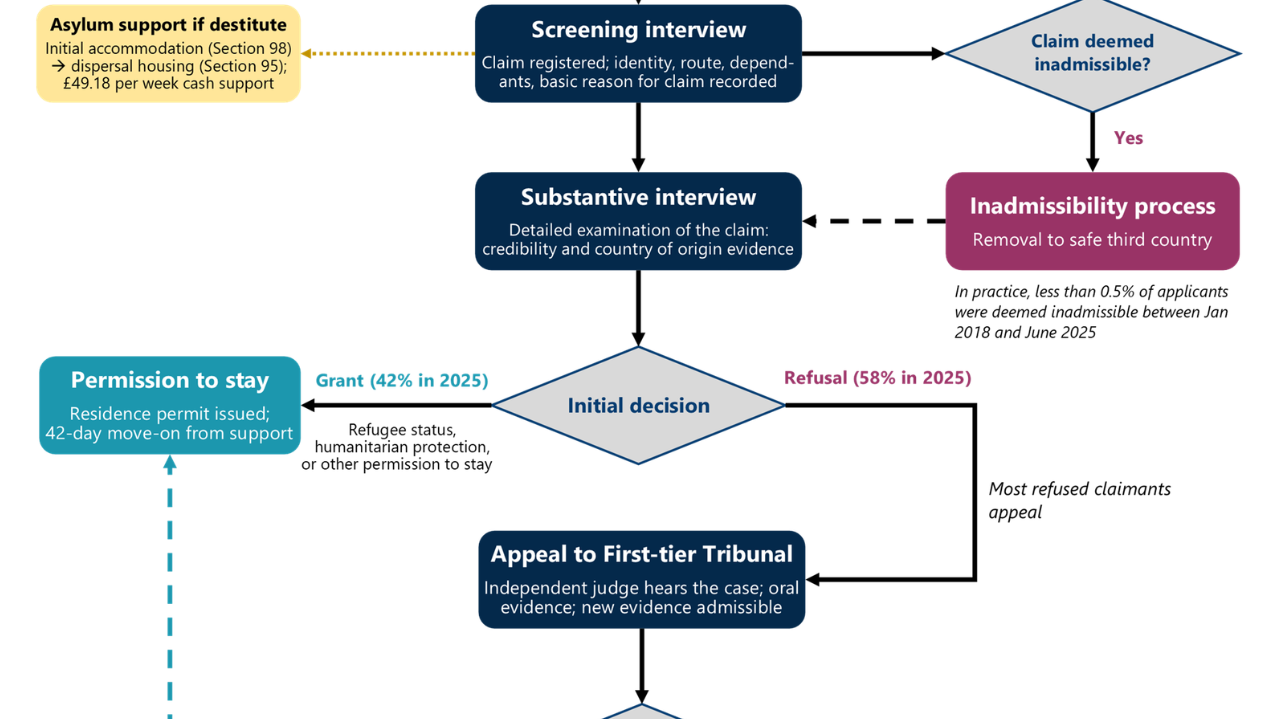
Source: Migration Observatory analysis.
Notes: This process map is simplified and so does not show all possible trajectories, such as further appeals against decisions by the First-tier Tribunal.
Acknowledgements
With thanks to CJ McKinney for detailed feedback on a draft of this Q&A.


Home / publications / commentaries /
Q&A: The UK’s asylum process
12 Jun 2026