
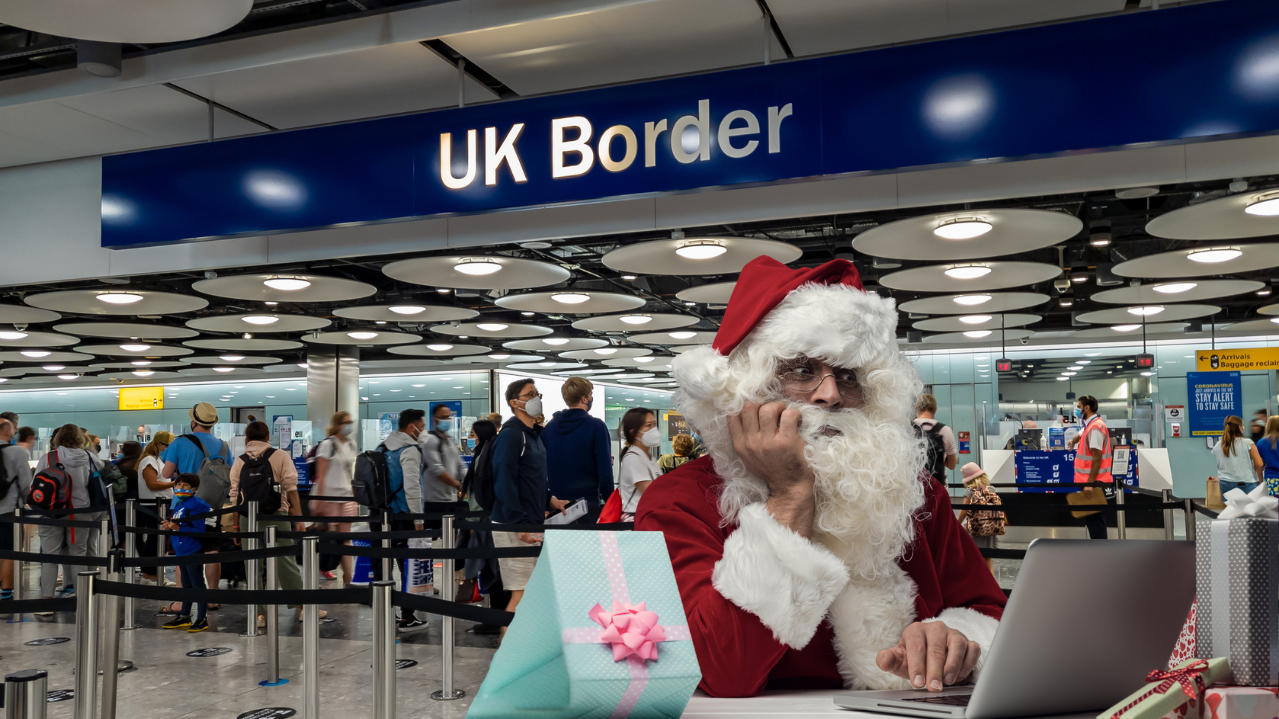
Well, it’s the holiday season once again. Santa is about to embark on his marathon border-crossing exercise and will be making sure the reindeer have their passports. Even more importantly, the Migration Observatory tradition of a roundup of the year in UK migration policy and developments is also upon us.
This year has been wild for policy and data wonks like us, with numerous policy announcements, shifts in net migration, and a focus on issues that previously didn’t play much of a role in the debate, like crime and asylum accommodation.
Below are the big moments from the rollercoaster that was 2025.
January
After a spectacularly eventful 2024, it might have been tempting to imagine that 2025 would see a period of iterating rather than completely reimagining UK migration policy. But January’s introduction of the Border Security Bill already signalled that this was not going to be the case.
The bill repealed the Conservative Party’s flagship Rwanda policy and many of the provisions of the Illegal Migration Act that prevented the processing of asylum claims. It introduced “counter-terror” powers to challenge people smuggling – including increased penalties for assisting illegal immigration and the ability to seize electronic devices and the establishment of a statutory position of Border Security Commander with wide-ranging powers to lead the Border Security Command and combined operations involving members of agencies such as the National Crime Agency, Border Force and MI5. It received royal assent in December 2025, and any impacts are yet to be seen.
February
February’s Home Office migration statistics showed a big reduction in the number of visas issued in 2024. While these falls were mainly driven by policies introduced by the Conservative Party to tackle a dramatic rise in legal immigration – a rise created mainly by a series of liberalisations introduced by the Boris Johnson administration – they were maintained by the Labour Party after the July 2024 election.
These changes included increased wage requirements for most work visas, higher income thresholds for British people or settled migrants in the UK wishing to bring a foreign spouse or child to live with them, and restrictions on student dependants.
May
The presumed outcome of February’s visa statistics – a massive decline in immigration – was confirmed in May’s Office for National Statistics (ONS) migration statistics, which showed a fall of 50% – from 860,000 to 430,000 – the largest drop in net migration ever recorded (though this was from a record peak) in the year to December 2024.
The Immigration White Paper, published in May, outlined a raft of measures designed to reduce migration to the UK, largely completing the process of rolling back the post-Brexit immigration liberalisations. The White paper proposed increases in the time it would take for many migrants to get settlement in the UK (of which more later), increased language requirements, and measures to restrict the scope of human rights immigration routes.
July
In July, the UK announced its new “one in one out” deal with France – a move that the government hoped would deter small boat arrivals (of which, again, more later. A series of work-related restrictions came into force, notably an increase in the salary threshold for skilled work visas to £41k, the removal of some middle-skilled jobs from the work visa system, and the closure of the care route to overseas recruitment. The care route had been roundly criticised for poor oversight, creating space for fraud and labour exploitation. An issue to watch in 2026 will be whether international students already in the country continue to switch into the care sector at the same rate as in the past.
August
There were a number of protests outside asylum hotels, which led to a wider debate about the link between migration and crime. We explained what the data can tell us – and what it can’t – in our commentary.
Epping Forest District Council was granted a High Court injunction (subsequently overturned on appeal) to stop a hotel which was housing asylum seekers, based on planning law. The political fallout was significant and intensified the debate about how to house asylum seekers – the Observatory’s analysis is here.
September
September brought the announcement of “BritCard” – a new digital ID for everyone legally resident in the UK that would be used to consolidate access to government services, and ensure migrants have the right to work – and the first removals under the one-in-one-out scheme with France took place.
November
Net migration statistics were published showing a continued decline to 204,000 in the year ending June 2025, a fall of 78% and a return to pre-Brexit levels. November’s data also showed that the “appeals backlog” – mainly made up of people who have been refused asylum and appealed against the decision is now overtaking the initial decisions backlog. There are lots of ramifications of this, and it’s our strong sense that it’ll be a bigger and bigger deal throughout 2026 if it doesn’t start coming down, not least because it’s a major factor behind the government’s failure to make progress towards its pledge to end the use of asylum hotels.
A White Paper on asylum proposed a “Danish style” approach, making it harder for refugees to settle in the UK permanently. Changes to the asylum system and human rights rules will aim to process legal challenges and appeals more quickly, and make it harder for people to challenge their removal. The Observatory’s analysis of this new, more temporary approach to refugee protection can be read here.
A consultation was also announced on settlement rules. The proposals include a shorter path to permanent status for the highest-paid migrants. In contrast, migrants who entered illegally, overstayed a visa, or claimed benefits would remain on temporary statuses for longer – up to 20 or 30 years. The government also plans to restrict access to welfare benefits for people with permanent status but not citizenship. The Observatory’s comment on the settlement changes is available here.
December
While November was possibly the busiest single month we’ve had since launching the Observatory in 2011, December has provided us with a grand finale. Our Top Ten Problems in the Evidence Base for Public Debate and Policy-Making on Immigration in the UK in 2025 report highlighted the challenges in developing policy without good data. The top 10 report shows challenges in understanding the characteristics of the migrant population, the impacts of migration on public finances, the benefits system and crime, the number of people arriving and leaving and the number of unauthorised migrants.
Early December saw the longest lull in small boat crossings since 2018, though this was nowhere near enough to prevent 2025 from becoming the second-highest year for small boat crossings after 2022.
And the cherry on the Observatory’s Christmas cake is the publication of our latest briefing, which looks at Modern Slavery and Migrants in the UK.


Home / publications / commentaries /
2025: Review of the year
19 Dec 2025