

Some migrants to the UK stay permanently while others leave after a period of time. This briefing explains what we know about how long migrants stay in the UK after arrival.
-
Key Points
- The majority of foreign-born people living in the UK have lived here for 10 years or more.
More… - A substantial share of non-UK citizens coming to the UK do so temporarily, but there is no single way of calculating what share of migration is temporary.
More… - Most non-UK nationals who leave the UK do so within 5 years.
More… - Among non-EU citizens, family migrants are more likely to stay long term than people coming on work or study visas.
More…
- The majority of foreign-born people living in the UK have lived here for 10 years or more.
-
Understanding the Evidence
Calculating how long migrants stay in the UK is difficult, both because there is no single definition of where a ‘stay’ starts and ends, and because there is no single data source that tracks each migrant over time. ...Click to read more.A picture of migrants’ duration of stay must therefore be gleaned from a variety of data sources, while keeping the respective strengths and limitations of the data sources in view. This briefing uses the latest full-year data available at the time of writing, which, for this update, are typically for 2019. As such, COVID-19’s impact on migration trends and the data used to measure them are not explored in this briefing. Estimates on international migration are generated by the UK’s Office for National Statistics (ONS) using the International Passenger Survey (IPS), which collects information from travellers entering and exiting the UK at its airports, seaports and the Channel tunnel. The IPS asks travellers arriving in the UK how long they intend to stay. People who say they are moving to the UK for at least a year are counted as long-term migrants. Long-term migration estimates are therefore based on people’s migration intentions. The IPS also collects data from people as they leave, asking, if they are moving away from the UK, how long they had stayed. There are two categories of short-term migrants: those who lived in the UK for at least three months but less than a year (UN definition) and those who lived in the UK for between one month and one year. As opposed to long-term migration estimates, short-term migration estimates are based on how long people say they actually stayed when they leave. Short-term migration estimates also differ from long-term estimates in that they reflect the number of trips or stays, not the number of individuals, as the same person could make more than one short-term trip in a given year. The IPS was suspended in March 2020 because of the COVID-19 pandemic, accelerating ONS’ ‘transformation journey’ towards the production of migration estimates based on administrative data sources (see ONS, 2020).
The Annual Population Survey (APS) collects data on people living in the UK. Among other things, the APS asks individuals when they arrived in the UK and can therefore be used to calculate how long migrants have lived in the UK at a given point in time. However useful the APS is, there are some important caveats to bear in mind. For example, it cannot be used to track inflows and outflows of people over time, information about local areas and smaller population groups are often unreliable, and recent arrivals and certain population sub-groups appear to be underrepresented, which makes it difficult to infer emigration rates from changes in the population of people from a given year-of-arrival cohort. The COVID-19 pandemic has changed the way that some data are collected for the APS, affecting estimates and their reliability. For more information about these changes, see the ONS publication, Coronavirus and its impact on the Labour Force Survey.
Home Office data on visa issuances (including ‘migrant journey’ data) and entries/exits at the border can in theory be used to assess the duration of migrants’ stay. Until the post-Brexit immigration system comes into force, these data are only available for non-EU citizens. Other limitations of the data include the fact that people issued a visa do not necessarily enter the country and typically do not stay right up to the date their visa expires.
There is no single definition of a ‘migrant’. This briefing examines data on people with non-UK nationality and non-UK country of birth depending on the dataset. When examining immigration inflows, nationality and country of birth lead to very similar results. However, when examining the population of people living in the UK, the number of non-UK nationals will generally be lower than the number of non-UK born because of naturalisations, particularly among non-EU citizens. For more discussion, see the Migration Observatory briefing, Who Counts as a Migrant.
-
Understanding the Policy
While migration debates tend to distinguish between ‘temporary’ and ‘permanent’ migration, these categories can be defined in different ways. ...Click to read more.Legally, people can be given permanent rights to remain in the UK. This is known as Indefinite Leave to Remain (ILR). Non-EU citizens generally require ILR in order to stay in the UK for many years, but the duration of stay before a person receives ILR varies depending on the visa type. For example, skilled workers become eligible for ILR after 5 years and cannot extend their Tier 2 (general) work visa beyond 6 years. Prior to Brexit, EU citizens did not require a particular status to stay permanently. Following Brexit, non-Irish EU citizens and their non-EU family members who have been resident in the UK before 1 January 2021 and wish to remain are required to apply to the European Union Settlement Scheme (EUSS) for ‘settled status’ (ILR) or ‘pre-settled status’ by 30 June 2021. For more information about the EUSS, see the Migration Observatory report, Unsettled Status – 2020: Which EU Citizens are at Risk of Failing to Secure their Rights after Brexit?. EU citizens who wish to move to the UK after 30 December 2020 will be subject to broadly the same rules as non-EU citizens.
Having ILR does not mean that a person will necessarily stay forever, however. Conversely, people granted temporary visas could, in theory, make repeated visits and thus spend a large proportion of their years in the UK (although they will generally be required to spend periods out of the country if they are not on a visa that leads to indefinite leave to remain).
The majority of foreign-born people living in the UK have lived here for 10 years or more
Out of the 9.5 million foreign-born people living in the UK in 2019, 5.8 million or 61% had lived in the country for 10 years or more (Figure 1). People born in non-EU countries are more likely to have been in the UK for longer. In 2019, 66% of the 5.8 million non-EU born population had been in the country at least 10 years, compared to 53% of the 3.6 million EU born population.
Figure 1
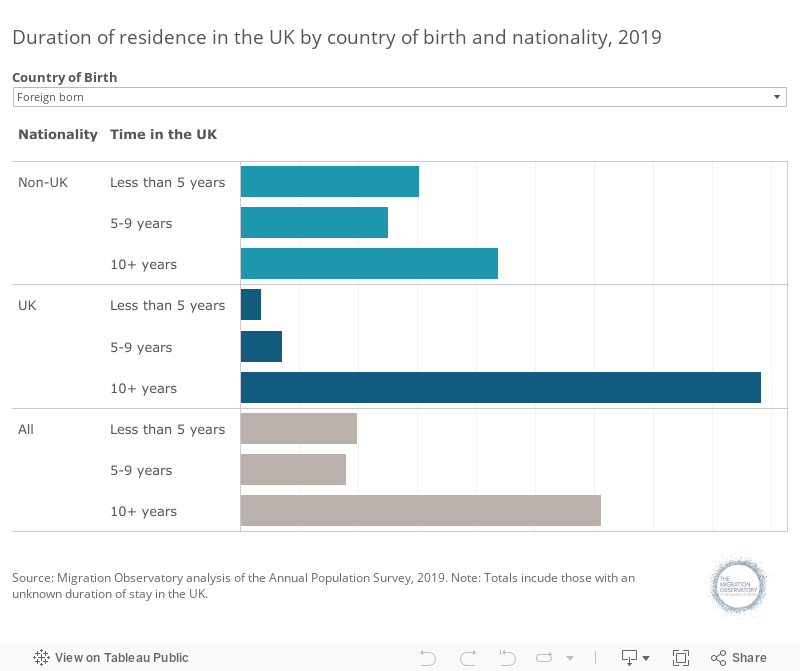
Rates of UK citizenship among the foreign-born population increase with duration of residence – a reflection of increased eligibility for citizenship (which requires at least 5-6 years of residence) and having more time to make a successful application. In 2019, an estimated 88% of both EU and non-EU born UK citizens had lived in the UK for ten years or more.
EU migrants have traditionally been much less likely to become UK citizens than those from non-EU countries. For more discussion of citizenship, see the Migration Observatory briefing, Citizenship and naturalisation for migrants in the UK.
There is no single way of calculating what share of migrants leave the country
Many non-UK citizens who come to the country do so for short periods and would not necessarily be classed as ‘migrants’ by some definitions. Others stay for several years before leaving the country, and many settle permanently in the UK. Some may come back and forth. This makes it difficult to produce a single number summarising what share of migrants are ‘temporary’ vs ‘permanent’.
A substantial number of people coming to the UK do so for less than 12 months. In the five-year period from mid-2014 to mid-2018 inclusive, non-UK citizens made an annual average of 1.02 million short-term trips to the UK lasting 1-12 months, of which roughly 290,000 were at least 3 months long (Table 1).
Many long-term migrants (i.e. those who come to the UK for at least a year) also leave after a period. The second panel of Table 2 shows average long-term inflow and outflow figures over the ten years 2010 to 2019 inclusive. During this period, there was an annual average of 530,000 long-term arrivals and 200,000 long-term departures. (Note that these figures exclude UK citizens, who are included in the ONS’ headline quarterly net migration figures for the same period.)
Table 1
Total average annual inflows and outflows of non-UK citizens by duration of stay
| Short term migration inflows, years ending mid-2014 to mid-2018, annual average, England and Wales | Inflows and outflows | |
|---|---|---|
| All moves 1-12 months | 1,020,000 | |
| - Of which for employment or study | 340,000 | |
| All moves 3-12 months | 290,000 | |
| - Of which for employment or study | 170,000 | |
| Long-term migration inflows and outflows, 2010 to 2019, annual average, UK | Inflows | Outflows |
| All reasons | 520,000 | 200,000 |
Most non-UK citizens who leave the UK do so within 5 years
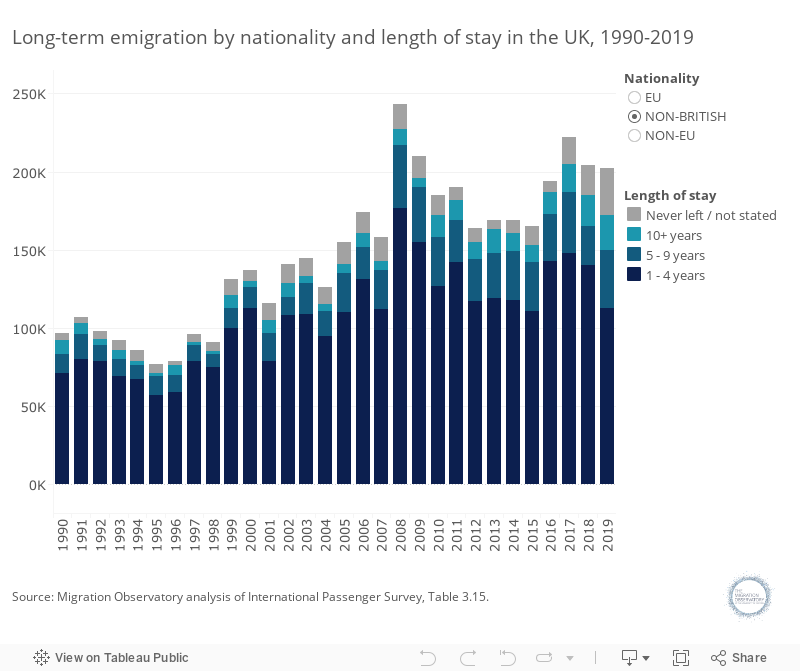
Between 1990 and 2019, a majority of non-UK nationals who left the UK had lived here for less than 5 years: between 56% and 82% each year (Figure 2). The data suggest that once migrants have been in the UK for several years, it becomes increasingly likely that they will stay permanently. Overall emigration from the UK averaged about 100,000 per year during the 1990s, 160,000 during the 2000s and 190,000 during the 2010s. However, only small numbers of non-UK citizens who have lived in the UK for more than 10 years leave – an average of 10,000 per year between 1990 and 2019.
Figure 2
Family is an important driver of permanent settlement
The majority of non-EU citizens issued a visa to come to the UK for family, work or study do not become settled residents in the long term. In 2014, 348,800 visas were issued to non-EU citizens for work, study or family reasons, including as dependants joining or accompanying others in the UK. Of these, 258,000 or 74% had expired by the end of 2019, requiring the visa holder to leave the country (although some may later return on a new visa).
There is some evidence that non-EU migration is more likely to be temporary than in the past. The cohort of non-EU citizens issued visas in 2014, for example, is less likely to have permission to stay in the UK at the end of the fifth year than those who were granted their visa in 2004, for whom 60% of visas had expired after that period of time (Home Office, 2020).
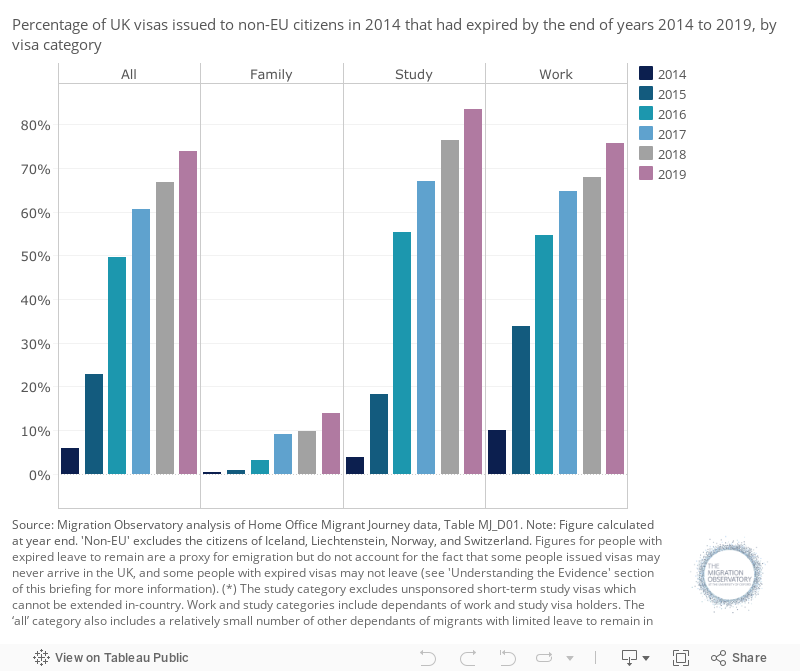
Figure 3 shows the percentage of non-EU citizens granted visas in 2014 to come to the UK for work, family, or study, whose visas had expired between 0 and 5 years after arrival and thus who are expected to have left the UK. (Note that nearly all those without permission to remain in the UK are thought to leave the UK before their visa has expired – see Home Office, 2019.) After 5 years, work and study visas are much more likely to have expired than family visas.
At the end of 2019, 83% of the 171,900 study visas issued to non-EU citizens in 2014 had expired, i.e. the holder had not stayed on with a different visa, nor had they received indefinite leave to remain or citizenship. The same applied to 76% of the 137,000 people issued work visas.
By contrast, only 14% (4,100) of the 29,200 family visas issued in 2014 had expired five years later. Of the total cohort who were granted a family visa in 2014, 40% (11,600) had some form of temporary permission to remain and 46% (13,600) had received ILR (permanent settlement) by the end of 2019.
Figure 3
For various reasons, nationals of certain non-EU countries stay for longer in the UK than others. Among non-EU citizens who received family visas in 2014, for example, 82% of Syrians and 47% of Indians had gained settlement five years later, compared to 34% of Americans and 29% of Australians. Among work visa recipients, 31% of Pakistanis, 20% of Chinese and only 7% of Americans and 4% of Australians had been granted settlement.
This is down in part to the type of visa they hold: citizens of some countries are more likely to come on family visas, rather than work or study visas. Citizens of less wealthy countries are also thought to be more likely to remain long-term, taking up citizenship in the UK and the EU at higher rates than migrants from high-income countries (see the Migration Observatory briefing, Citizenship and naturalisation for migrants in the UK, and Dronkers and Vink, 2012).
Students are the least likely to settle in the UK after five years. No more that 3% of students of any non-EU nationality who were issued a visa in 2014 had settled by the end of 2019. As the Migration Observatory briefings, International Student Migration to the UK and Migrant Settlement in the UK outline, non-EU migrants who enter on a student visa and go on to receive settlement typically do so on a 10-year track to settlement.
The likelihood of remaining in the UK also varies by age. Among those issued visas in 2014, young people age 18 to 29 were less likely than other age groups to still have temporary or permanent leave to remain after five years (Home Office, 2020); this group is also most likely to have come on student visas, which do not offer a direct route to settlement. Children under the age of 18 were the most likely to still have valid leave to remain or settlement at the end of the fifth year after arrival (40%); these children primarily come as dependents of someone on a temporary visa (Home Office, 2020).
Evidence gaps and limitations
The main source of data on emigration (and thus duration of stay) is currently the International Passenger Survey (IPS). However, there are some known problems with IPS estimates of emigration of certain groups, the reasons for which remain unresolved. Preliminary analysis from the ONS published in July 2018 compared the IPS figures, which are used to calculate net migration, with Home Office data on visas issued and entries or exits from the UK. It found that while estimated immigration inflows in the two sources were similar, the IPS showed much less emigration than the Home Office data (ONS, 2018). The gap was driven primarily but not exclusively by non-EU students, whose emigration appears to be significantly undercounted in the net migration figures. What this means for the measurement of emigration among other groups—i.e. non-EU nationals coming for other reasons and EU nationals—remains unclear. For this reason, it is currently difficult to compare emigration trends by place of birth.
Some studies have used the Labour Force Survey or Annual Population Survey to examine emigration patterns, by looking at how the size of a given cohort of migrants (e.g. those arriving in 2006) changes over time (e.g. how many are still living here in 2007, 2008, and so forth). For example, Migration Watch (2017) uses the LFS to estimate how many migrants arriving from 2008-2014 were still in the UK in 2010-2016. For non-EU citizens, the patterns are roughly as expected: the estimated size of a given year-of-arrival cohort decreases over time, presumably due to emigration. For EU citizens, however, the cohort sizes mostly do not decrease and in some cases actually increase over time. This is quite different from the picture provided by IPS data, which show EU national emigration of 75,000-140,000 per year since 2008. While one should not expect a perfect match between the two data sources due to differences in measurement and methodology, the difference between the two results—one of which suggests substantial EU emigration and one of which does not—is surprising and makes it difficult to make conclusive statements about what share of EU citizens emigrate.
Finally, it is worth noting that the concept of ‘duration of stay’ is itself not always clear and can be difficult to operationalise in the data. For example, an international student who studies on a 3-year course in the UK but returns home each summer for 2 months and leaves permanently at the end of his or her studies would intuitively be defined as having stayed in the UK for 3 years, even though each individual trip lasted only 10 months. As a result, the ONS notes that: “it is not straightforward to generalise the patterns that are seen within the data to come up with definitive rules around how to classify someone as a long-term migrant” (ONS, 2018).
References
- Dronkers, J., & Vink, M. P. 2012. Explaining access to citizenship in Europe: How citizenship policies affect naturalization rates. European Union Politics, 13(3), 390-412.
- Home Office 2019. Fourth report on statistics being collected under the exit checks programme. Available online.
- Home Office. Migrant Journey: 2019 report. Available online.
- ONS 2017. International migration data and analysis: Improving the evidence. Available online.
- ONS 2018. Report on international migration data sources: July 2018. Available online.
- ONS 2020. Population and migration statistics system transformation – overview. Available online.
- Migration Watch 2017. The need for continued inflows of EU workers to the UK. MW 401. Available online.


