

This briefing examines settlement or indefinite leave to remain (ILR), which is when a migrant is granted the right to live indefinitely in the UK. It looks at how many non-EU migrants settle in the UK, and discusses the post-Brexit EU Settlement Scheme.
-
Key Points
- The majority of non-EU migrants who received an initial visa between 2004 and 2017 did not acquire settlement (ILR) in the UK.
More… - A quarter of people granted settlement in 2022 were initially granted family unification visas, reflecting the fact most people who migrate for family reasons stay in the UK long-term.
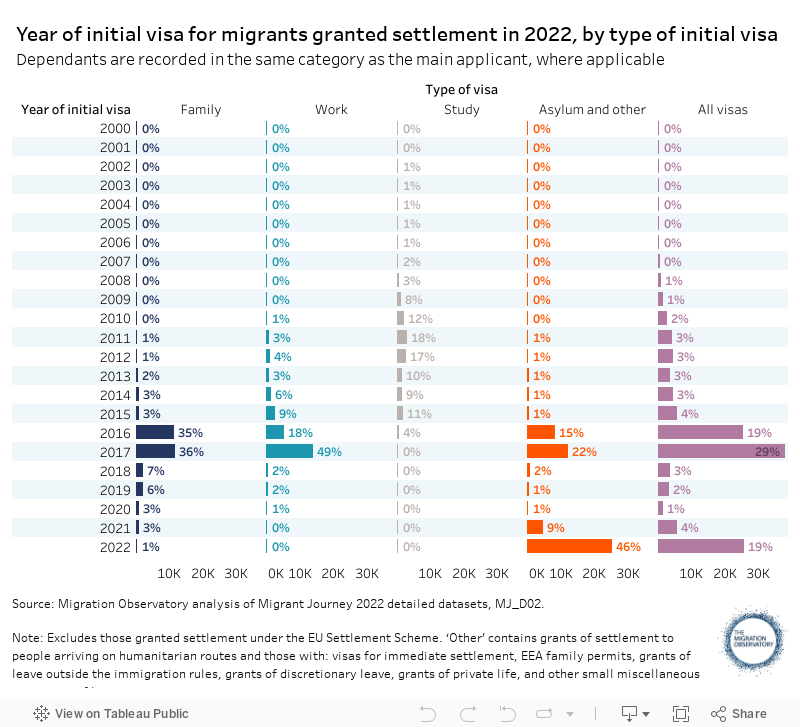
More… - Half of all migrants granted settlement in 2022 had been in the UK on a temporary visa for between five and seven years, and around one in eight took ten years or more.
More… - The number of settlement grants in a given year is influenced by changes in how applications are processed, and not just long-term net migration levels.
More… - The cost of an application for settlement (ILR) has increased several times over the past two decades, reaching £2,885 in October 2023.
More… - By the end of September 2023, 1.8 million EU citizens held pre-settled status under the EU Settlement Scheme for people living in the UK before Brexit and thus did not yet hold a secure permanent residence status.
More…
- The majority of non-EU migrants who received an initial visa between 2004 and 2017 did not acquire settlement (ILR) in the UK.
-
Understanding the policy
Most migrants enter the UK on temporary visas that restrict their rights in various ways (e.g. they may only be allowed to do certain activities and are not usually able to access welfare benefits). ... Click to read more.After a few years, people on certain types of temporary visas can apply for permanent status, also known as settlement, indefinite leave to remain (ILR), or ‘settled status’.
Settlement gives people more security and certainty about their status (although it is possible to lose this ‘permanent’ status in some circumstances). People granted settlement are free to work or study in the UK; access state benefits; use the NHS; sponsor an immigration application, such as that of a spouse wishing to join them; and register their UK-born child as a British citizen.
A grant of settlement is not the same as being given citizenship. British citizenship entitles the recipient to a British passport and to vote in general elections, while settlement does not.
Before the end of free movement at the end of 2020, EU citizens did not need to apply for settlement to stay long-term in the UK. However, since 1 January 2021, EU citizens have been subject to the same immigration rules as non-EU citizens, and thus to live permanently in the UK requires either settlement – which, if they arrived before 1 January 2021, they can apply for under the EU Settlement Scheme (EUSS) – or a temporary status granted by the government (see below). This briefing refers to the ‘EU’, but the same rules on movement and settlement apply to Switzerland and the European Economic Area, which includes the EU countries plus Iceland, Liechtenstein, and Norway. Irish citizens are allowed to live and work in the UK through separate arrangements that were not affected by Brexit and are considered to be settled from the day they arrive in the UK.
To be eligible for settlement, non-UK citizens (including EU citizens arriving in the UK from 1 January 2021) must have lived in the UK on a qualifying temporary visa for a certain period of time, usually five years. Time spent on some visas, such as student visas or intracompany transfer visas, does not count towards the residence requirement for settlement. A person may also qualify for settlement if they have lived in the UK legally for a continuous period of ten years – a route known as ‘Long Residence’.
To receive settlement, most migrants will also have to pass a ‘Life in the UK’ test and demonstrate sufficient knowledge of the English language.
EU citizens (and their family members) who arrived in the UK before the end of 2020 are eligible for ‘settled status’ under EUSS if they can show they have lived in the UK for a continuous period of at least five years. If the applicant has lived in the UK for less than five years, they will usually receive ‘pre-settled status’, which allows the applicant to receive settled status once they have accrued the necessary five years’ residence.
-
Understanding the evidence
Data on settlement come from the Home Office, as part of its Immigration System Statistics Quarterly Release. ... Click to read more.These data take account of the appeal and reconsideration of cases.
This briefing relies primarily on Home Office data on the visa status of non-EU migrants over time, also known as ‘Migrant Journey’ data. This information provides the immigration status of an annual cohort of new entrants at the end of each calendar year after their arrival and is used to calculate the proportions of those granted a visa in a given year who have received a grant of settlement (or citizenship, which requires settlement) in subsequent years. This briefing groups people who hold either settlement or citizenship together because a grant of citizenship requires settlement. Data on people issued visas in each route also include their dependant family members. Thus, for example, dependants of work migrants will generally be included in the ‘work’ settlement figures, not in ‘family’.
Until the end of 2020, EU citizens did not require visas and so were not included in the main settlement figures (although there are separate statistics on the EU Settlement Scheme and on permanent residence documents issued).
There are no visas for the purpose of seeking asylum. However, people granted settlement on the basis of asylum can be separately identified by looking at whether they had an asylum-related type of leave immediately prior to being granted settlement.
The majority of non-EU migrants who came to the UK between 2004 and 2017 did not acquire settlement
The majority of migrants who received an initial visa during the past two decades did not go on to acquire indefinite leave to remain (ILR) or settlement, according to available data (which uses visa data from non-EU citizens). No non-EU migrant cohort receiving visas between 2004 and 2012 had more than a 31% settlement rate in 2022, at least ten years after they were issued their initial visa (Figure 1). That is, around 70% no longer held a valid visa and were thus expected to have left the country.
Settlement rates vary by the type of visa on which someone comes to the UK, however. At the end of 2022, at least 75% of family migrants who received an initial family visa between 2004 and 2016 had received a grant of settlement, considerably higher than the settlement rates of study and work migrants over the same period (no higher than 19% and 27% respectively).
Figure 1
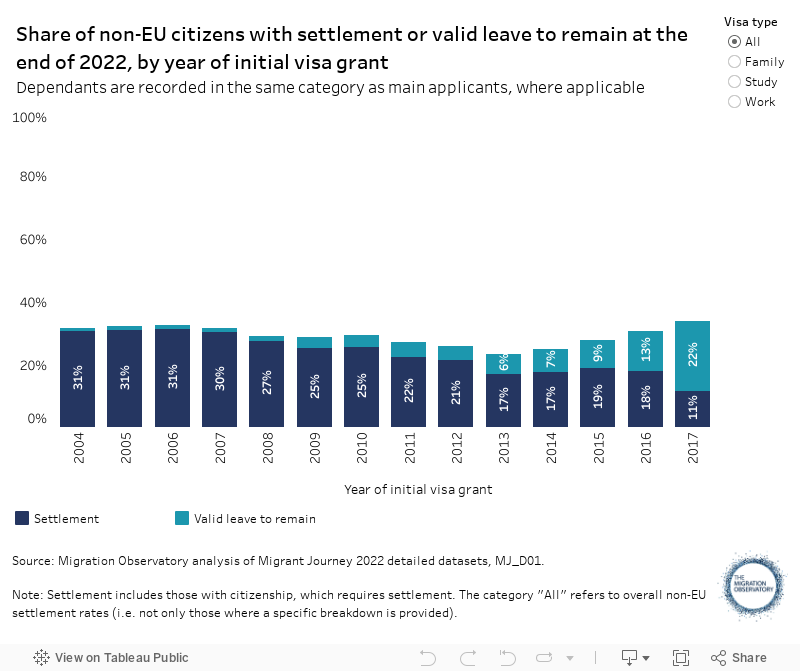
The longer that migrants have lived in the UK, the more likely they are to have acquired settlement. Many non-citizens who do go on to acquire settlement do so within six years of first receiving their initial visa to come to the UK, and almost all do so within ten years.
A little under half of those granted settlement in 2022 were initially granted family unification or work visas
Figure 2 shows the number and share of migrants granted settlement in 2022 by their initial visa type and the visa type they held at the point they were granted settlement. Of the 133,000 migrants granted settlement in 2022, a quarter initially entered the UK on a family visa, and a fifth initially came to the UK on a work visa. These were also the most common types of visa held by migrants immediately before their grant of settlement.
Figure 2
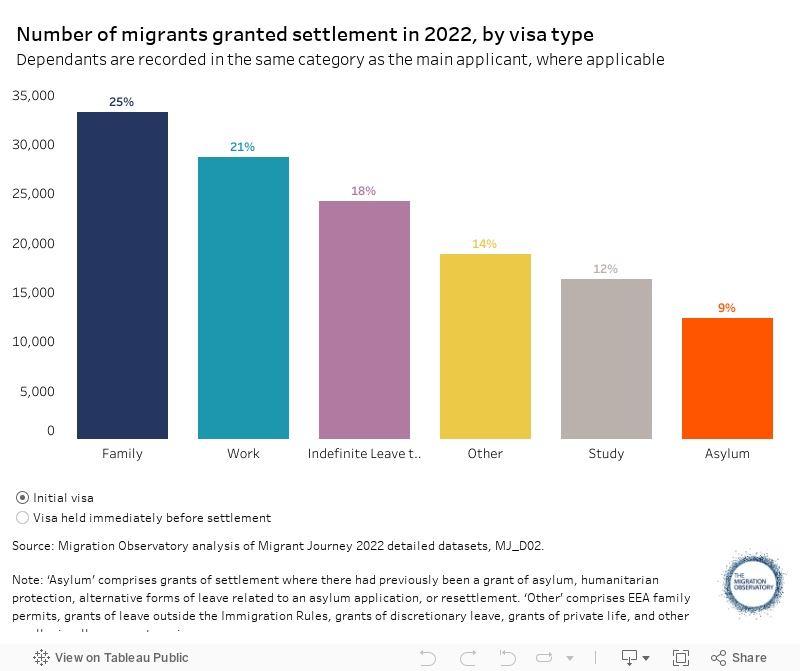
Family makes up a relatively small share of visas granted, but people who initially received a family visa were the most likely to be granted settlement in 2022 (see Figure 1). By contrast, the share of settlement grants that went to migrants issued an initial work visa reflects the size of this migration route—between 2015 and 2017, around 30% of non-EU immigration to the UK was for this reason. This was the second most common reason, behind study (around 50%).
However, the share of settlement grants for migrants who initially entered the UK on study visas was only 12% in 2022. This is a smaller share than in previous years due to policy changes that made it harder for international students to stay in the UK after graduation to work, mostly notably the closure of the post-study work route in 2012. A new post-study work route—the graduate route—was introduced in July 2021, but the effects of this will not be seen for several years because the time spent on study and post-study work routes does not count towards settlement. For more information about the graduate route, see the Migration Observatory briefing, International student migration to the UK, and the Migration Observatory commentary, International students entering the UK labour market.
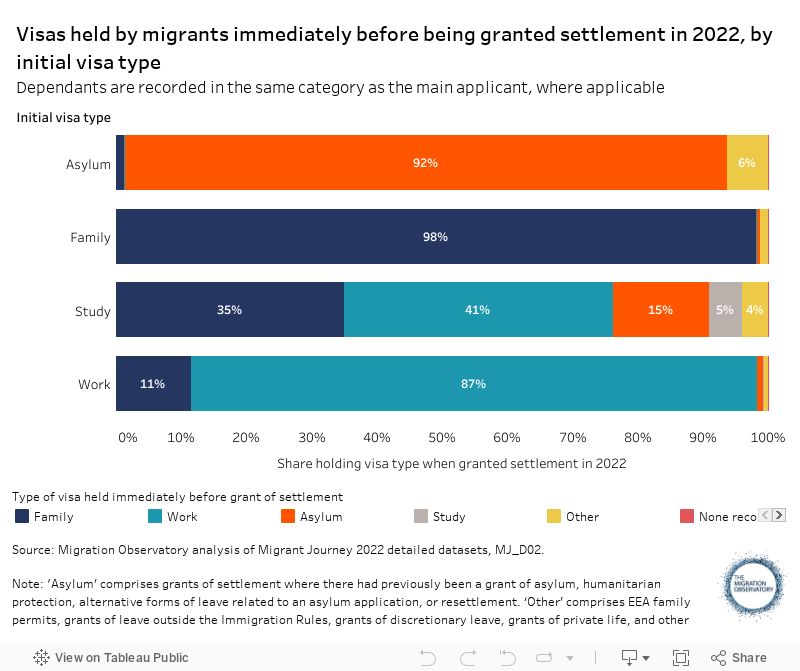
Among migrants granted settlement in 2022, most of those who came to the UK on an initial family or work visa or for the purpose of claiming asylum acquired settlement via the same route (Figure 3).
Figure 3
Half of all migrants granted settlement in 2022 had been in the UK on a temporary visa for between five and seven years
Looking at all migrants granted settlement in 2022, almost half received their initial visa in 2016 or 2017 (Figure 4, All visas). Around one in eight people (16,000) took ten years or more to gain settlement (i.e., received their initial visa in 2012 or earlier).
Just under one in five (25,700) received their initial visa or grant of leave in the same year they were granted settlement or citizenship (i.e., in 2022). The large majority of the latter group were granted settlement upon arrival in the UK, known as ‘indefinite leave to enter’ (ILE). This share was unusually high in 2022, in part because many of the people relocated from Afghanistan that year were given immediate settlement. Among those eligible for ILE are people who previously had settlement and are returning to the UK after an absence of more than two years.
The time it takes for a migrant to be granted settlement is highly dependent on the type of visa on which they first came to the UK (Figure 4). Whereas over 70% of family and work migrants granted settlement in 2022 were on a five-year route to settlement, the most common duration for those who initially arrived on a student visa was eleven years.
Figure 4
However, in recent years an increasing share of family unification migrants (i.e., partners and children joining British citizens or settled residents in the UK) have been on a ten-year route to settlement. This is most common where migrants do not qualify under any of the mainstream immigration routes but where the government recognises that they have a claim to remain in the UK for human rights reasons. More information about ten-year routes to settlement can be found in the Migration Observatory briefing, Migrants on ten-year routes to settlement in the UK.
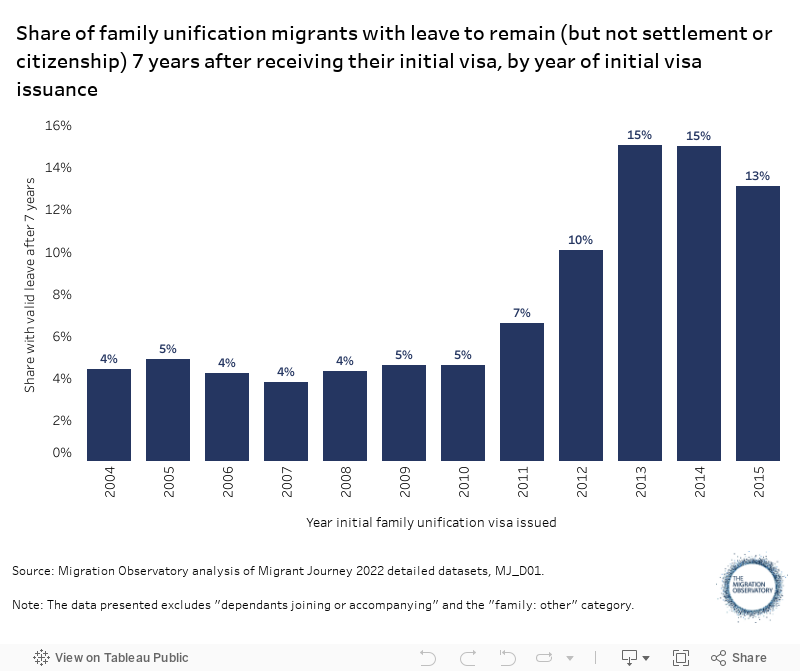
The rising number of people on ten-year routes to settlement will not be reflected fully in statistics for another few years because most are not yet eligible for settlement, but the increase in individuals taking a longer route is indicated by the share of people with leave to remain seven years after initially being issued a family visa (Figure 5). For example, of the 31,600 people issued a family visa in 2015, 13% (4,100) had valid leave to remain, but not settlement or citizenship, at the end of 2022. This share is around three times greater than for cohorts arriving from 2004 to 2010 before the current system of ten-year routes to settlement was introduced.
Figure 5
Grants of settlement are influenced by a number of factors
The number of settlement grants in a given year is not a simple reflection of immigration levels a few years earlier—settlement policy can also play a role. For example, the fall in settlement grants between 2010 and 2016, and the steady increase from 2017 onwards, owed in part to a 2012 policy change that lengthened the residence requirement for family migrants from two to five years and thus delayed some settlement grants that would otherwise have been made in earlier years (Figure 6).
Figure 6
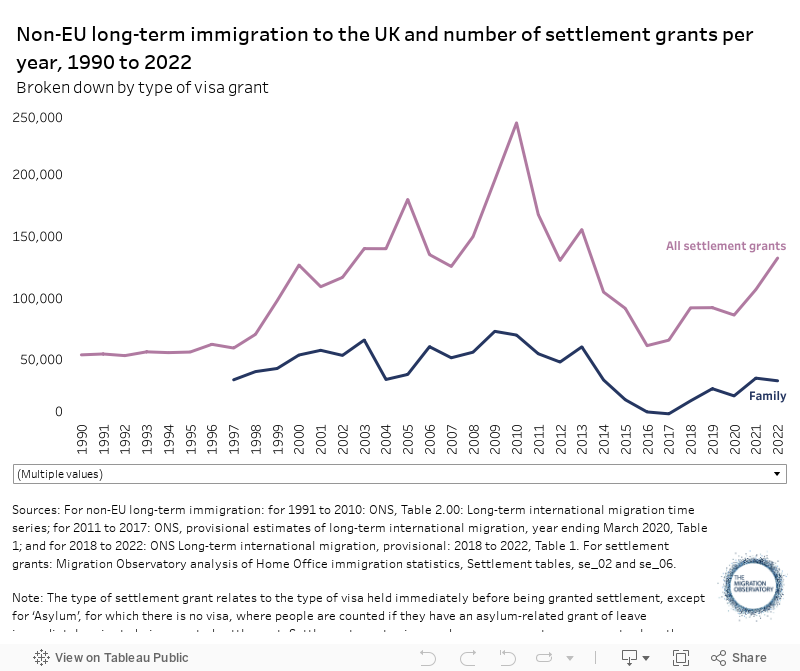
Another factor that influences the number of settlement decisions is the allocation of resources within the Home Office. For example, in 2010, there were around 240,000 grants of settlement, the highest level since comparable records began in 1960. This was an outlier, driven primarily by a government programme to clear an asylum backlog that resulted in grants of settlement to asylum applicants.
The cost of an application for settlement has increased several times over the past two decades, standing at £2,885 in 2023
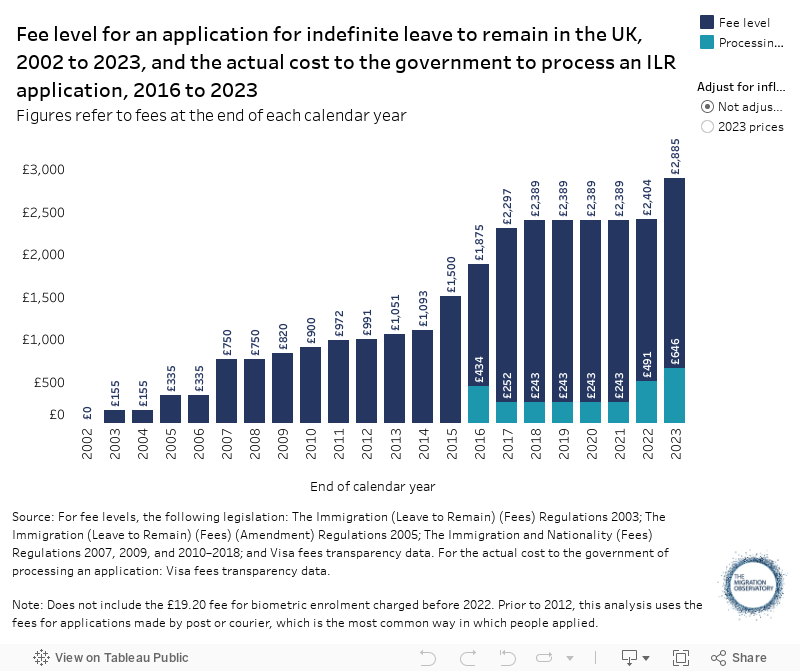
In 2003, a fee of £155 was introduced for an application for indefinite leave to remain. Since then, the application fee has been increased several times, reaching £2,885 on 4 October 2023 (Figure 7). This fee also applies to each dependant (i.e., partner and any children) of a non-EU citizen applying for settlement—therefore, a family of four who are all applying for settlement would need to pay £11,540 in application fees alone. These fees must be paid at the point of application and are not refunded if the application is refused.
Since 2016, the government has published the estimated actual cost of processing immigration applications. The estimated actual cost to the government of processing an application for settlement in October 2023 was £646, 24% of the fee charged.
Figure 7
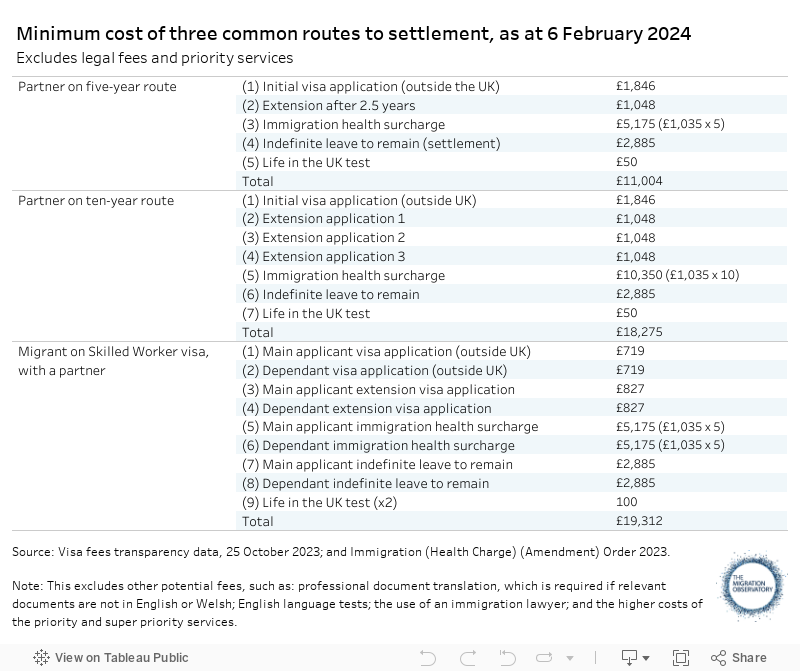
The total cost in immigration fees is higher if one includes prior immigration applications and other fees that must be paid before a person can apply for settlement, such as the Immigration Health Surcharge. For example, based on fee levels as at 6 February 2024, a partner on a five-year route to settlement would pay just over £11,000 in fees, while a skilled worker with one dependant would pay around £19,300 (Table 1). For a further discussion of immigration charges, see the Migration Observatory Q&A, Immigration fees in the UK.
Table 1
By the end of September 2023, 5.3 million EU citizens held either settled or pre-settled status under the EU Settlement Scheme.
Prior to the UK’s departure from the European Union on 1 January 2021, EU citizens and their families had the right to live, work and access services in the UK upon arrival, and they did not need to apply for settlement to stay long-term. The government’s EU Settlement Scheme (EUSS) was introduced to maintain these rights and provide a route to settlement for those who arrived before the end of 2020. For more information, see the Migration Observatory briefing, EU Migration to and from the UK.
By the end of September 2023, 6.2 million people had applied to EUSS. Of these, 5.7 million applicants were EU citizens, higher than the official estimate of approximately 4 million EU citizens living in the UK in 2021. This difference is primarily a result of two factors: some EU citizens will have applied to EUSS but subsequently left the UK, and official statistics may underestimate the size of the EU migrant population. Among the 5.7 million EU citizens who had applied to EUSS, an estimated 3.5 million had been granted settled status by the end of September 2023, and a further 1.8 million held pre-settled status (Figure 8). The most recent Home Office statistics on the EU Settlement Scheme are available here.
Figure 8
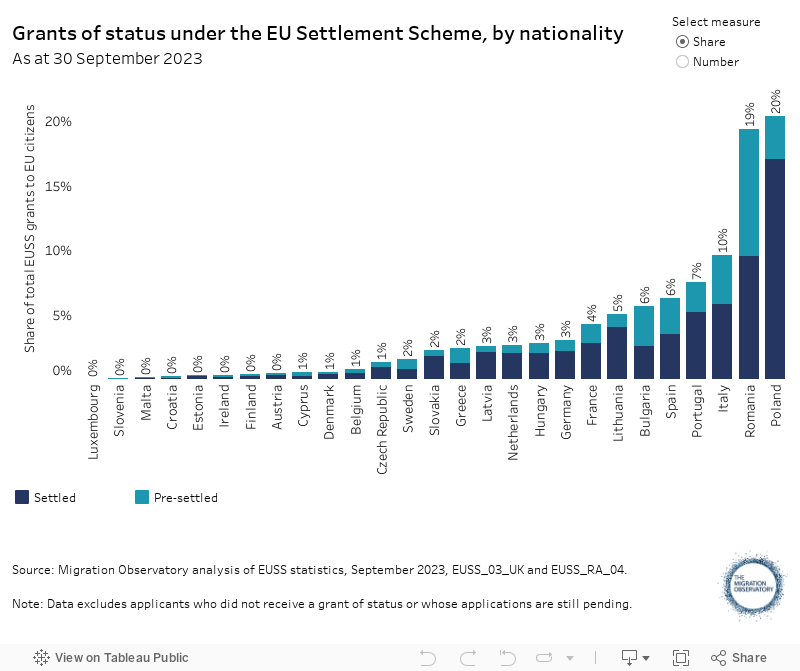
Pre-settled status is temporary; those holding it are required to apply for settled status once they have accrued 5 years’ residence, or they risk lapsing into irregular status upon its expiry. In September 2023, the Home Office started automatically extending pre-settled status by two years for those who had not applied for settled status, and it has announced that it will begin automatically upgrading as many pre-settled status holders as possible, once they become eligible, in 2024.
It is unclear, however, what will happen to people at the end of the two-year extension if they have not applied for settled status, nor the extent to which pre-settled status holders will be automatically upgraded to settled status. Such a system may miss a significant number of pre-settled status holders who become eligible for an upgrade but do not leave a sufficient administrative trail of their continuous residence. For more discussion of the issues facing pre-settled status holders, see the Migration Observatory commentary, Outstanding issues facing the EU Settlement Scheme.
Evidence Gaps and Limitations
The impacts of policy changes on settlement are often difficult to determine. It takes several years for policy changes to work their way through the system since changes are generally introduced only for newly arriving people.
Acknowledgements
With thanks to Nicolas Rollason for providing valuable feedback on the 2019 version of this briefing and CJ McKinney for help updating the 2020 version.
References
- Home Office (2012). Impact assessment. Home Office.
- Home Office (2023a). EU Settlement Scheme statistics, November 2023. Home Office.
- Home Office (2023b). How many people continue their stay in the UK? Home Office.
- Home Office (2023c). Migrant journey: 2022 report. Home Office.
- Parliament (2020). Immigration: Northern Ireland: Written question – 475.
- UK Visas and Immigration (2024). Visa fees transparency data, Table with details of fees and unit costs – 2024. Home Office.


